
Hot Fuzz Stop Motion Adaptation
Evolution of a Scene
SHOT TO SCREEN
Drew Campbell
11/10/20254 min read
From Dock to Deck: Adapting the Scene
In a previous post, I outlined my initial vision for adapting the smuggling scene from Hot Fuzz into stop motion. Since then, that vision has shifted quite significantly. What started as a reasonably broad, almost cinematic idea has gradually been refined into something much more grounded, practical, and achievable within the constraints of time, scale, and physical production.
This process has been one of the most valuable learning experiences so far on Shot to Screen. Working in miniature forces every creative decision to be justified not just narratively but also logistically.
Rethinking the Scene in Physical Terms
One of the first significant changes came from accepting that not every idea translates cleanly into stop motion. When I revisited the smuggling sequence with the intention of physically building it, I realised that my original approach was too ambitious in terms of set complexity and character count. Rather than weakening the scene, this actually helped clarify it.
Focusing the action on a fishing boat immediately narrowed the visual language. It gave the scene a clear physical anchor and shifted my thinking from “how do I recreate the film moment?” to “how do I reinterpret it in a way that works for miniature filmmaking?”
Character Design and Time-Based Decisions
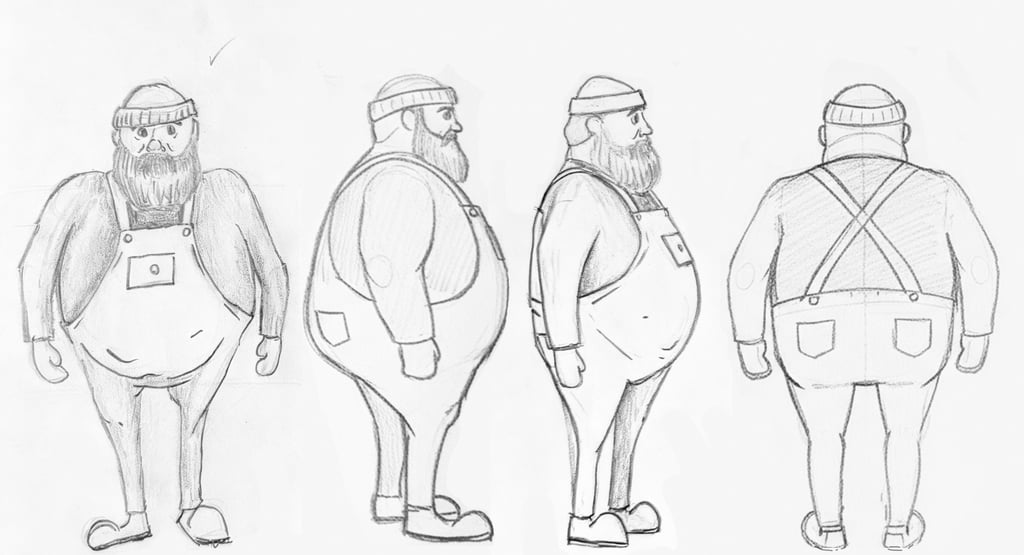
Another key shift has been my move away from AI-generated character concepts to hand-drawn turnarounds. While AI helped in early ideation, it didn’t offer the control or specificity I needed once I committed to building physical puppets.


Fig.1
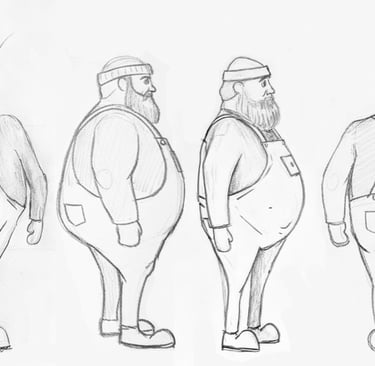
Due to time constraints, I deliberately limited myself to just two main character builds. Above (Fig.1) is Reg the fisherman, and below (Fig.2) is Reg’s grandson Davey, acting as deckhand for the day. Reducing the cast forced me to think more carefully about how to communicate character relationships visually, rather than through dialogue or crowd dynamics.
Fig.2
Visualising Before Building
At this stage, the most significant change in my workflow has been how heavily I’ve leaned on Blender as a previs tool. Rather than sketching shots in isolation, I’ve been using simple 3D layouts to generate reference images for storyboarding. This has made it much easier to test camera angles, scale relationships, and staging before committing to physical builds.
This approach mirrors professional previs workflows and has already saved time by identifying shots that would be impractical to achieve once everything is built in cardboard and foam. I’ll repeat this process when creating mock-up sets of the boat, lighthouse, rocks, and figures.
Below are a couple of example reference shots generated in Blender (Fig.3 and Fig.4).
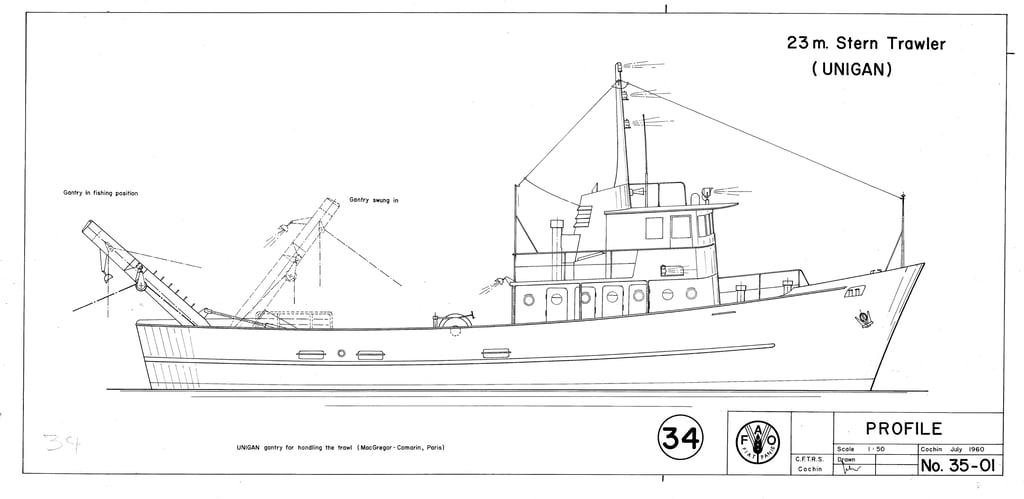
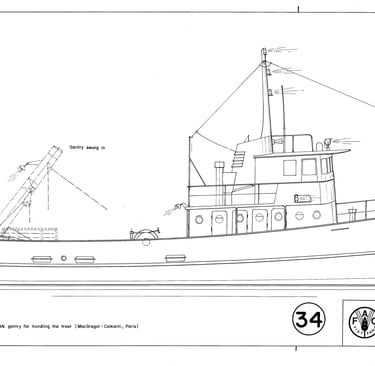
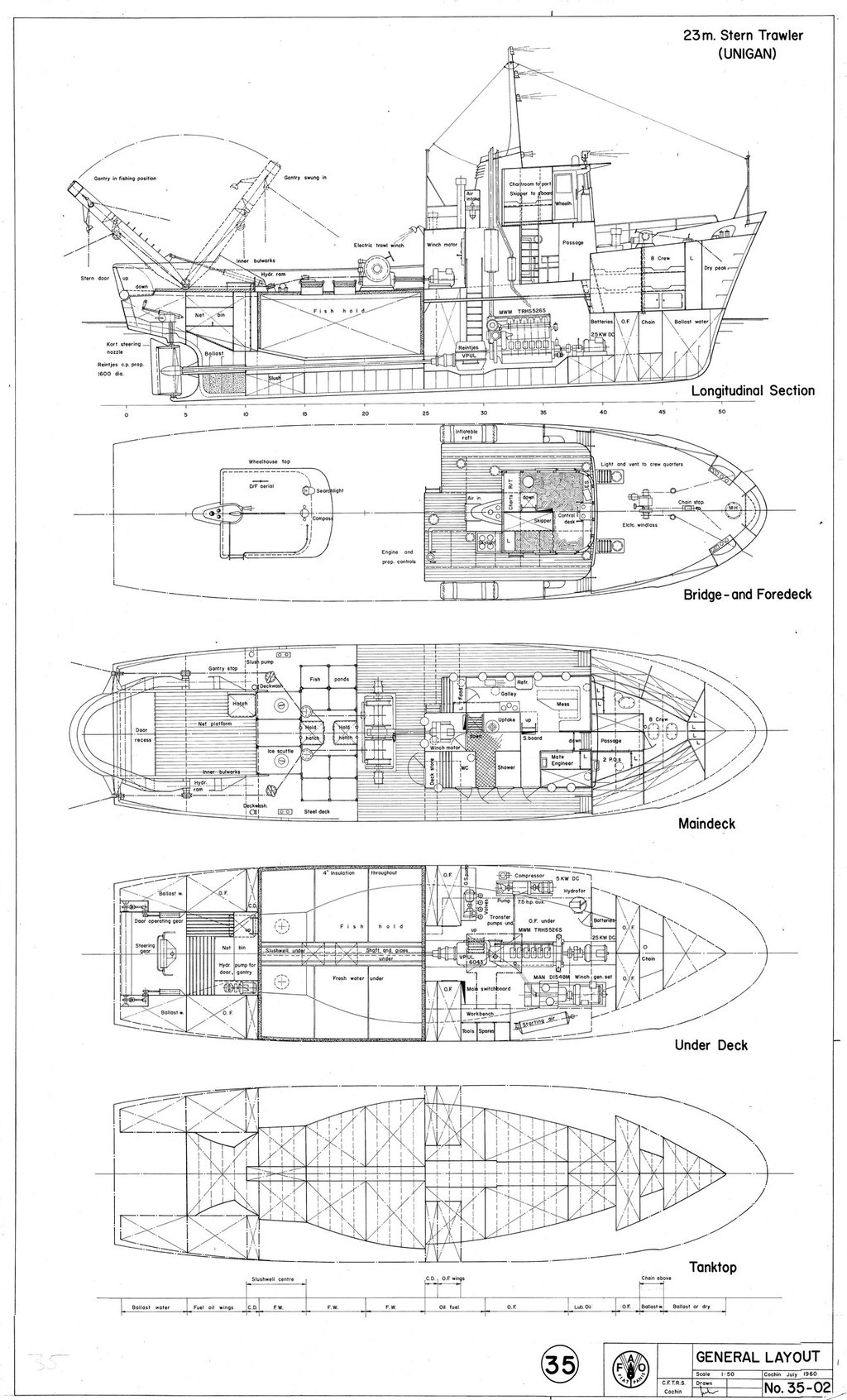
Fig.3
Fig.6
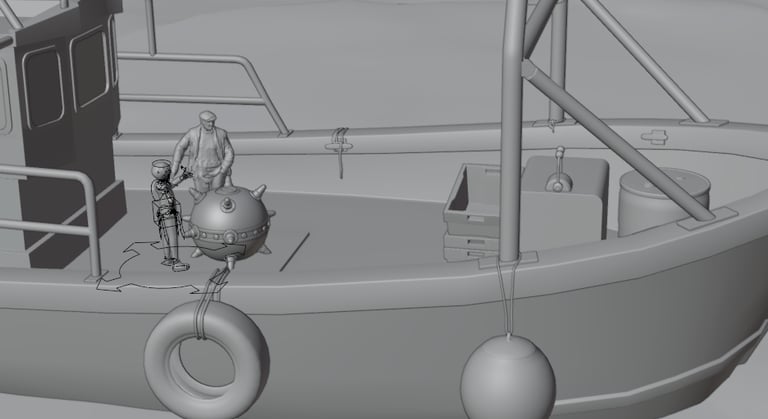
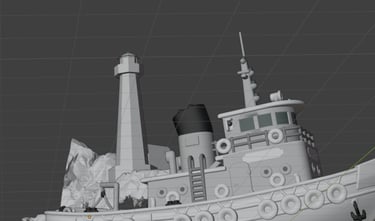
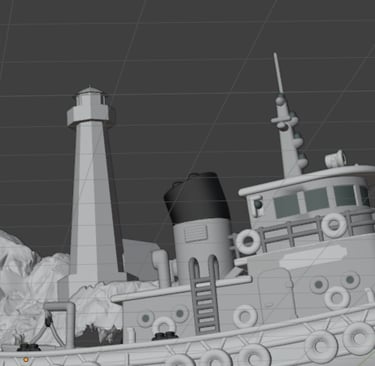
Fig.4
Scale, Miniatures, and Practical Compromise
As my vision became more grounded, scale became the defining constraint. I’ve decided to build a smaller cardboard mock-up of the fishing boat, while the lighthouse will be heavily scaled down and placed in the distance to suggest location rather than dominate the frame.
To inform this, I’ve been looking at real-world references, including plans for a 23m stern trawler. These have been useful not as blueprints but as a way to understand proportion and a believable layout when translating the boat into a miniature format (Fig. 5 and Fig. 6).
Fig.5
Reflection and Next Steps
Looking back, the most significant change since my earlier post is that my vision is no longer driven by what I want the scene to be, but by what it needs to be to work physically. Rather than feeling like a compromise, this has strengthened the project. The scene is more precise, more focused, and better suited to the stop-motion medium.
Next, I’ll finalise the boat design based on the reference and previs, begin building the cardboard mock-ups, and start testing lighting and camera placement. These tests will help lock down the final shot list before I commit to full-scale builds and animation.
Refrences
Campbell, A. (2025). Fig. 1: Reg the fisherman turnaround drawings [Pencil drawing].
Campbell, A. (2025). Fig. 2: Davey, Reg’s grandson turnaround drawings [Pencil drawing].
Fisheries and Aquaculture (2025). Fig. 5 and Fig. 6: 23 m stern trawler. Available at: https://www.fao.org/fishery/en/vesseldesign/ind-35 (Accessed: 20 December 2025).
No author (2025). Fig. 3 and Fig. 4: Fishing boat model. Available at: https://sketchfab.com (Accessed: 20 November 2025).
Business address: Voice of Drew, Carlisle, CA2 6ER | UTR: 7259771174 Copyright Drew Campbell 2024